

9.7 cm
26.8 cm
19.6 cm
9.2 cm
16.7 cm
9.8 cm
1.6 cm
16 cm
8.8 cm
The Aurora Hall-effect Propulsion System
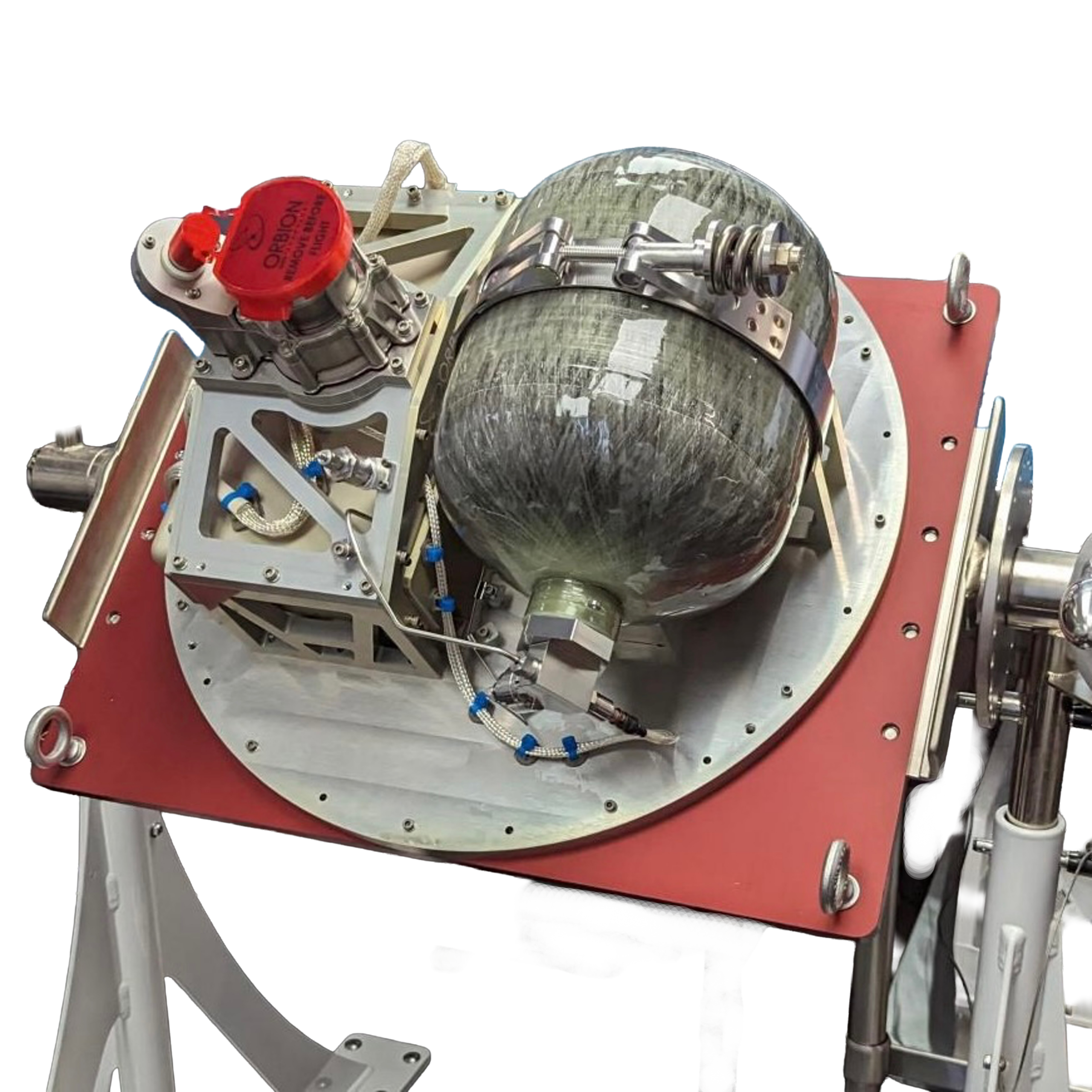
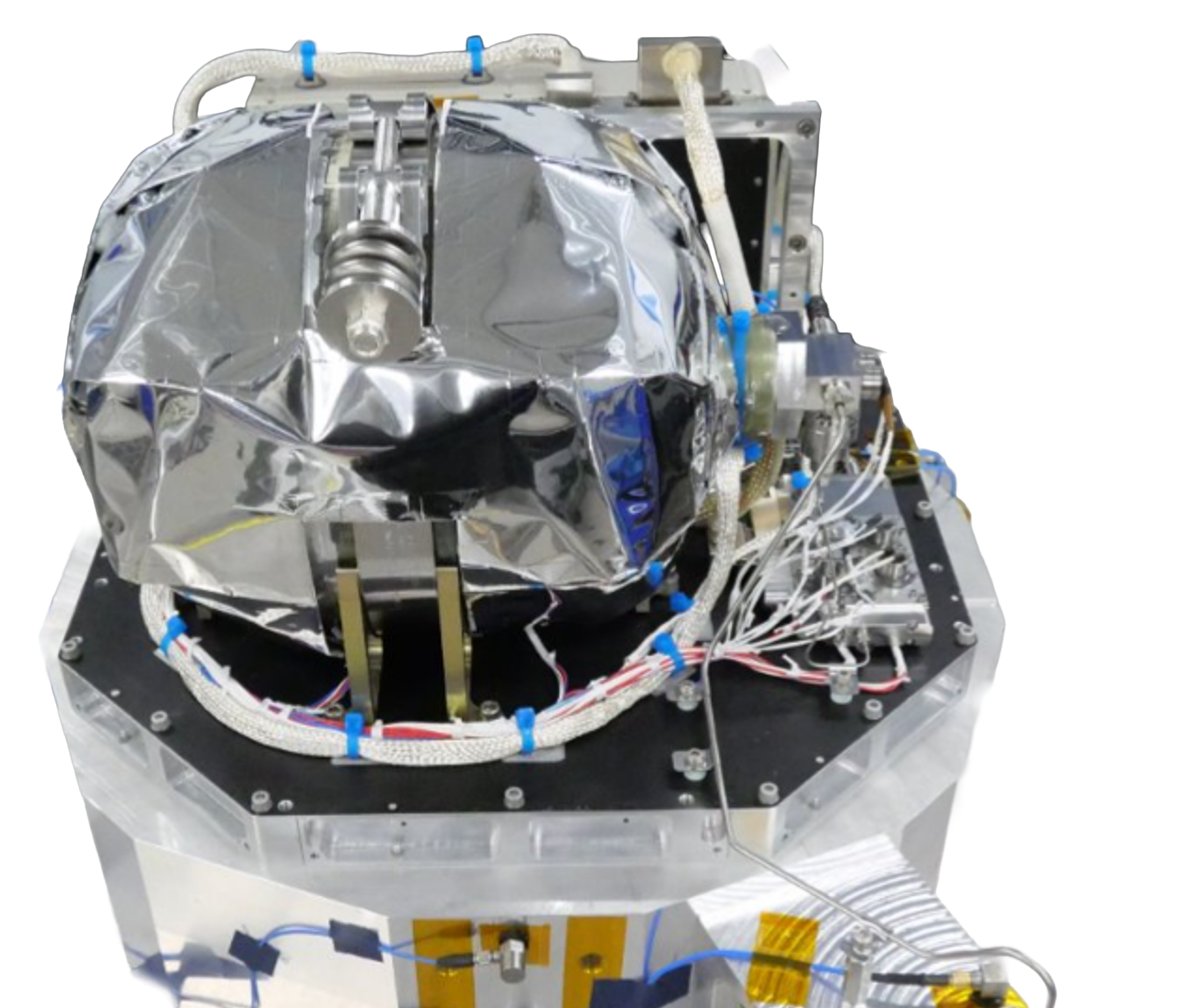
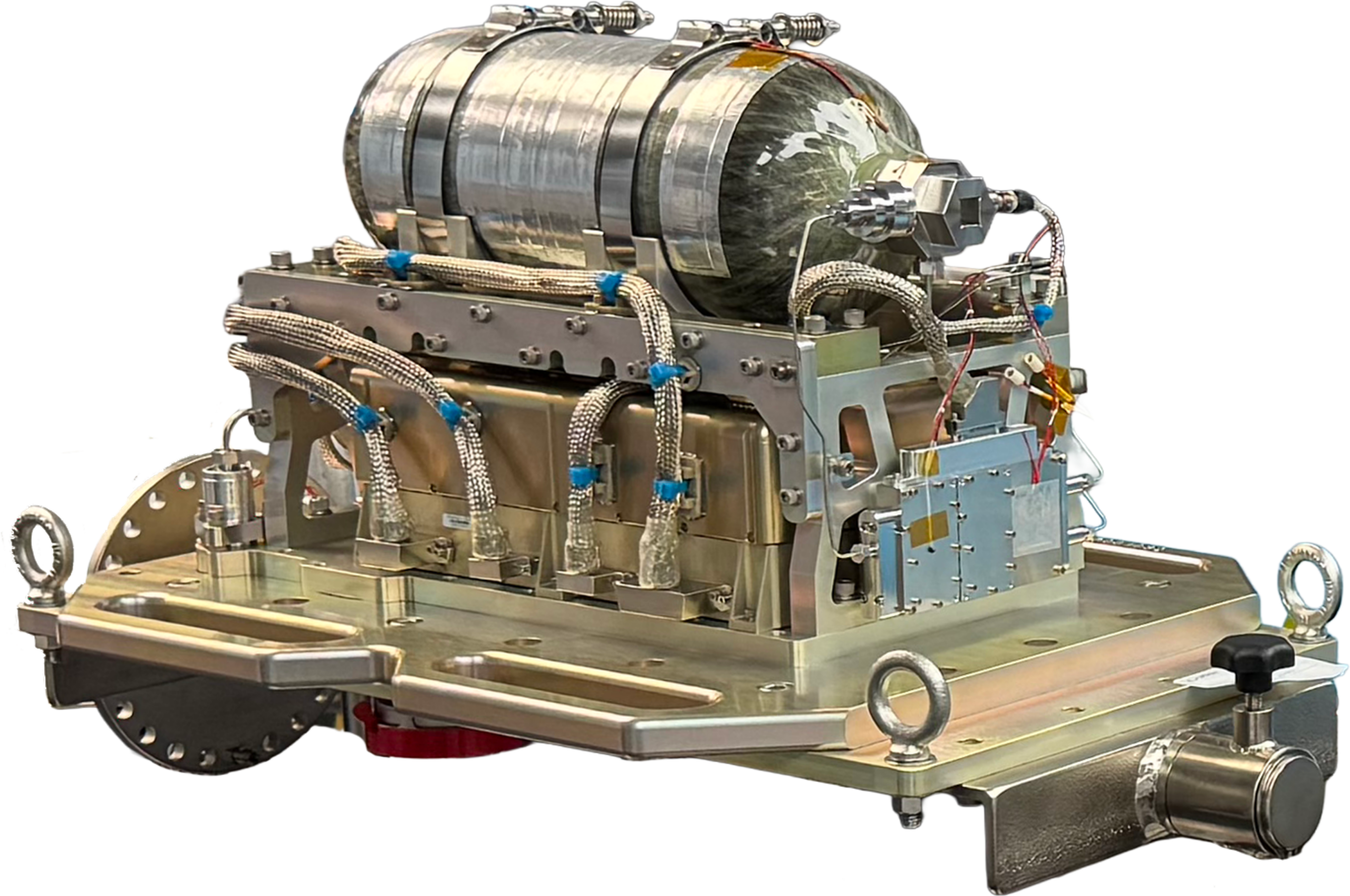
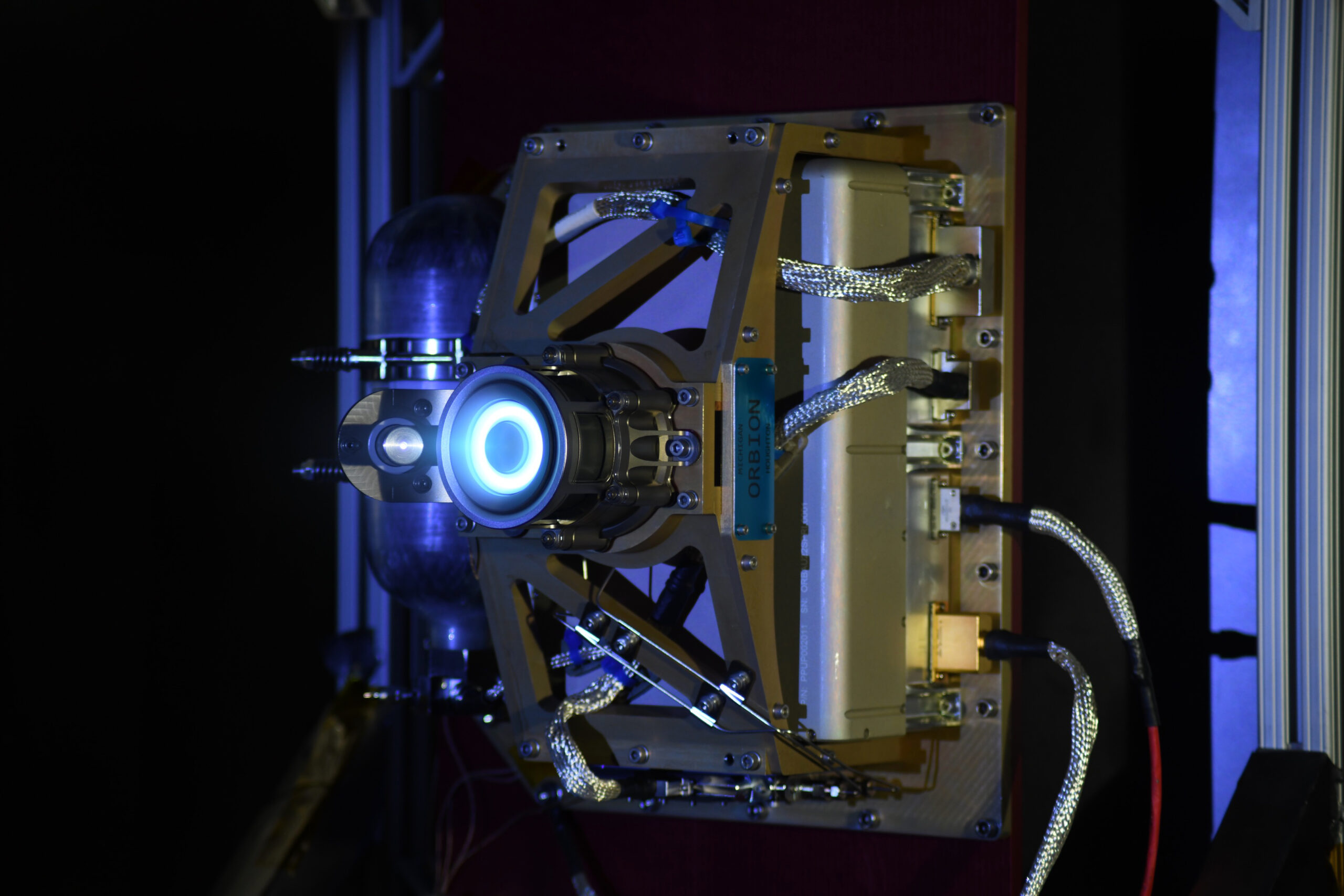
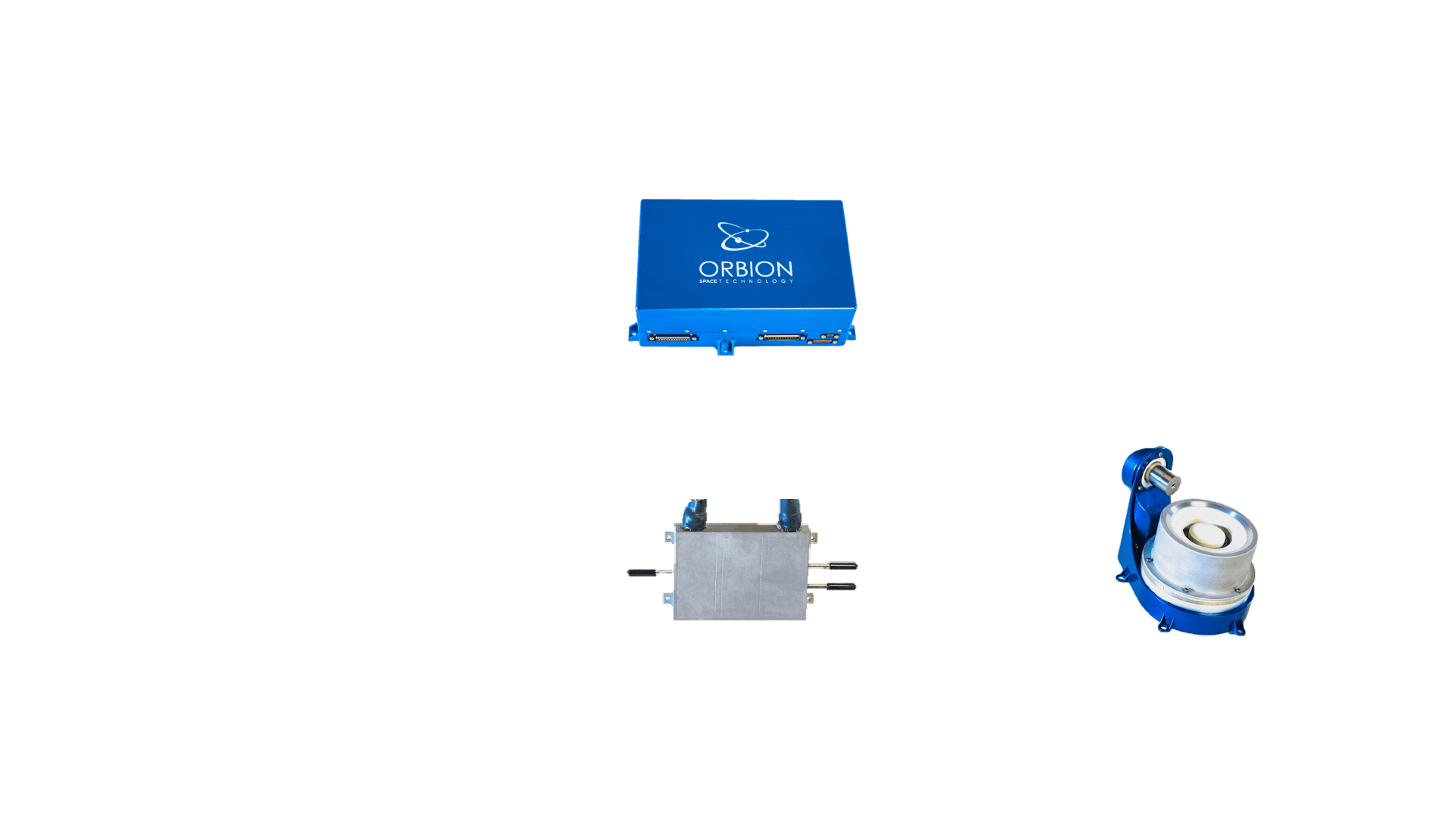
Aurora is a fully integrated Hall-effect propulsion system, comprised of a magnetically shielded thruster for ultra-long life and high total impulse, power processing unit, propellant management assembly, harness assembly, and storage tank.
* Not shown: Propellant Plumbing and Propellant TanksPower Processing Unit
26.8 cm x 19.6 cm x 9.7 cm
- 90% efficient
- 24 – 35 V S/C Bus input
- RS-422 Interface
- Other interfaces available upon request
- Total Ionizing Dose (TID) Options
- Pathfinder (5 krad TID)
- Constellation (25 krad TID)
- Cislunar (>100 krad TID)
- 5.8 kg
Hall-effect Thruster
9.2 cm x 9.8 cm x 16.7 cm
- Continuously throttleable from 100 – 300 W
- Xenon or Krypton
- Magnetically shielded
- Patent-pending ZeroTorque design has zero magnetic moment, so no perturbing magnetic torque on your spacecraft in LEO
- 1.5 kg
Propellant Management Assembly
16 cm x 8.8 cm x 1.6 cm
- Available exclusively from Orbion
- Interfaces directly with storage tank
- 1 anode, 1 cathode flow output line
- Proportional flow control – fully throttleable
- No direct interface necessary with spacecraft CDH
- Driven by PPU circuitry and software
- 50 mW
- 700 g
Aurora system physical specifications

Aurora’s modular design makes it easy to conform to your needs. The spacecraft interface is simple: A 28-volt unregulated power connection and an RS-422 data connection. We can either provide propulsion system components separately so you can locate them as desired within your spacecraft volume, or we can integrate the complete system on an element of spacecraft structure you provide.
Tell us what you need. We build it for you. Period.
| Parameters | Value | Unit |
|---|---|---|
| Mass* | 8 | kg |
| Dimensions (HET Envelope) | 9.2 x 9.8 x 16.7 | cm |
| Dimensions (PPU) | 26.8 x 19.6 x 9.7 | cm |
| Dimensions (PMA) | 16.0 x 8.8 x 1.6 | cm |
| PPU Input Voltage | 24-35 | V |
| PPU Data Interface** | RS-422 | |
* Not including propellant and tank ** Other options available |
| Product | Attributes | Typical Application | Collision Avoidance |
|---|---|---|---|
| Aurora | QML/QPL passive with QML/QPL ceramic active components having > 100 krad TID | Missions in MEO, GEO, or xGEO where reliability and TID are driving requirements | Available with El Matador |
Aurora System Overview
Orbion offers the Aurora system, a fully integrated and flight-proven electric propulsion solution built for demanding missions. Aurora delivers best-in-industry radiation-hardened electronics, the highest recognized assurance class, and industry-leading thrust, specific impulse, and lifetime in a compact SWaP envelope. Available with or without Orbion’s patented El Matador collision-avoidance capability.
Propulsion. Perfected.
Design Philosophy
Decades of laboratory testing and in-space heritage have proven that Hall-effect thrusters (HETs) possess an unrivaled combination of high thrust, specific impulse, and reliability. The Orbion Aurora is the next step in Hall-effect technology. Aurora was designed from the ground-up to be an affordable, reliable, mass-producible product. We didn’t just design a new thruster—instead, we designed an entirely new process.
Aurora is not a laboratory technology—it’s a workhorse product you can trust for your in-space maneuvers. You can count on our Aurora system to:
Maximize performance.
Class-leading thrust-to-power of over 60 mN/kW combined with 1,400 seconds of specific impulse reduces maneuver time, as well as propulsion system wet mass allowing you to carry more payload.
Simplify your interface.
With Aurora, we build on proven technology while pushing the state of the industry within practical measures. You can be assured that Aurora will not interfere with the important functions of your spacecraft. No RF noise. No spacecraft contamination. Just thrust when you need it – every time. Aurora’s flexible software interface makes it easy to control from your CDH. You can set thrust and burn duration and just fire-and-forget, or you can control detailed aspects of performance and retrieve operational parameters logged internally to the Aurora system.
Custom Integrated Modules
Standard components to build a custom module to fit your spacecraft and meet your mission requirements.

Benefits of Aurora
When compared to other products and technology currently available, the Aurora Hall-effect Propulsion System is the clear choice.
The Aurora system is manufactured using modern automation, with robots and automated test facilities replacing small teams of lab technicians in white coats. Our manufacturing process can produce one to two units per run, or 1,000 units per run—all of them enjoying the same low price and high reliability.

Based on proven technology

High-capacity manufacturing

Reduced launch payloads

Low-cost

System reliability

Propellant Comparison
If xenon didn’t exist in nature then DARPA would fund someone to develop it – because it is that good for propulsion. When stored under moderate pressure Xe is a supercritical fluid – meaning it has the high density associated with a liquid, yet it fills the container with no free surface and no sloshing. Krypton and argon have been used in place of Xe for some missions with the goal of reducing cost. The replacement is not without trade-offs and the propellant cost savings can be erased by system performance impacts that have associated costs of their own. Kr and Ar store at very low density, thus much larger storage volumes are required for the same propellant mass. The tanks must be at higher pressure and so require thicker walls which, when taken together with the larger size of the tank, translates to increased dry mass. Kr and Ar have lower propulsive performance than Xe and they cause faster erosion of thruster components which reduces the lifetime and achievable total impulse available to maneuver the spacecraft. Orbion offers the Aurora system for operation on either Xe or Kr. The slider and graphic show volumetric trades (at 20 deg. C) to store 15 kg of propellant. Note that flight systems typically require tanks capable of 1.5X maximum expected operating pressure and that storage pressure increases with tank temperature.
97.25 liters
Volume
1300 psia
Pressure
Argon
39.37 liters
Volume
1300 psia
Pressure
Krypton
8.29 liters
Volume
1300 psia
Pressure
Xenon
Propellant Comparison
If xenon didn’t exist in nature then DARPA would fund someone to develop it – because it is that good for propulsion. When stored under moderate pressure Xe is a supercritical fluid – meaning it has the high density associated with a liquid, yet it fills the container with no free surface and no sloshing. Krypton and argon have been used in place of Xe for some missions with the goal of reducing cost. The replacement is not without trade-offs and the propellant cost savings can be erased by system performance impacts that have associated costs of their own. Kr and Ar store at very low density, thus much larger storage volumes are required for the same propellant mass. The tanks must be at higher pressure and so require thicker walls which, when taken together with the larger size of the tank, translates to increased dry mass. Kr and Ar have lower propulsive performance than Xe and they cause faster erosion of thruster components which reduces the lifetime and achievable total impulse available to maneuver the spacecraft. Orbion offers the Aurora system for operation on either Xe or Kr. The slider and graphic show volumetric trades (at 20 deg. C) to store 15 kg of propellant. Note that flight systems typically require tanks capable of 1.5X maximum expected operating pressure and that storage pressure increases with tank temperature.
Space Mission System Trades for Xe, Kr, and Ar
Spacecraft mass, volume, and cost implications are shown for a canonical 200 kN-s total impulse mission.
|
|
Data included are from the NIST Chemistry WebBook, gas supplier quotes, tank supplier quotes, and publicly available literature/data | Argon | Krypton | Xenon |
|---|---|---|---|---|
| Atomic Mass (amu) | 39.9 | 83.8 | 131.3 | |
| Ionization Energy (eV) | 15.8 | 14.0 | 12.1 | |
| Cost ($/kg) | $3 | $350 | $3,500 | |
| Storage Density at 20ºC & 1300 psia (kg/m3) | 154 | 381 | 1808 | |
| Storage Density at 20ºC & 2600 psia (kg/m3) | 312 | 869 | 2114 | |
| Storage Density at 20ºC & 14000 psia (kg/m3)* | 966* | 1951* | 2737* | |
| Propellant Mass for 200 kN-s Mission (kg) | 12.0 | 17.0 | 15.7 | |
| 1300 psia | Tank Volume needed for 200 kN-s Mission at 1300 psia (L) | 77.9 | 44.6 | 8.7 |
| COPV Dry Tank Mass for 200 kN-s Mission at 1300 psia (kg) | 36.8 | 18.4 | 5.7 | |
| 2600 psia | Tank Volume needed for 200 kN-s Mission at 2600 psia (L) | 38.4 | 19.6 | 7.4 |
| COPV Dry Tank Mass for 200 kN-s Mission at 2600 psia (kg) | 18.4 | 12.3 | 5.7 | |
| 14000 psia | Tank Volume needed for 200 kN-s Mission at 14000 psia (L) | 12.4 | 8.7 | 5.7 |
| COPV Dry Tank Mass for 200 kN-s Mission at 14000 psia (kg) | Unrealistically high pressure – requires custom solution | |||
| Thrust per kW of Input Power (mN/kW) | 40 | 40 | 65 | |
| Specific Impulse for Sub-kW System (s) | 1700 | 1200 | 1300 | |
* Storage at 14,000 psia is not practical and included for comparison purposes.
Aurora System Specifications
Download a data sheet describing Aurora system performance and interfaces.
DownloadTECHNOLOGY
Hall-effect thrusters are the most trusted electric propulsion technology in the industry. See how they compare with other options.
Learn about our technologyMANUFACTURING
Orbion’s propulsion systems are manufactured using an optimal mix of touch labor and robotic assembly to increase reliability and decrease cost.
Learn about our manufacturingGet In Touch
Partner with us as we redefine what’s possible using small satellite technology.
Contact Us